RESTful API Design
本文参考 JavaGuide-系统设计-基础
什么是 API?
API(Application Programming Interface) 翻译过来是应用程序编程接口的意思。
我们在进行后端开发的时候,主要的工作就是为前端或者其他后端服务提供 API 比如查询用户数据的 API 。
但是, API 不仅仅代表后端系统暴露的接口,像框架中提供的方法也属于 API 的范畴。
为了方便大家理解,我再列举几个例子:
- 你通过某电商网站搜索某某商品,电商网站的前端就调用了后端提供了搜索商品相关的 API。
- 你使用 JDK 开发 Java 程序,想要读取用户的输入的话,你就需要使用 JDK 提供的 IO 相关的 API。
- ......
你可以把 API 理解为程序与程序之间通信的桥梁,其本质就是一个函数而已。另外,API 的使用也不是没有章法的,它的规则由(比如数据输入和输出的格式)API 提供方制定。
何为 RESTful API?
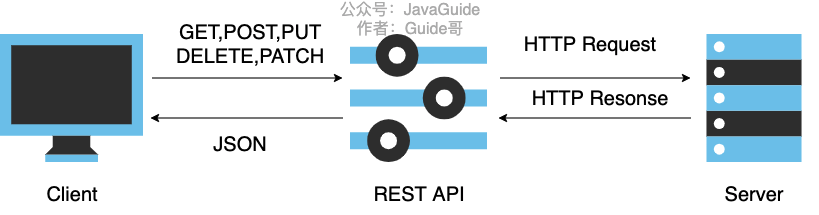
RESTful API 经常也被叫做 REST API,它是基于 REST 构建的 API。例如:
GET    /classes:列出所有班级
POST   /classes:新建一个班级
RESTful API 可以让你看到 URL+Http Method 就知道这个 URL 是干什么的,让你看到了 HTTP 状态码(status code)就知道请求结果如何。
像咱们在开发过程中设计 API 的时候也应该至少要满足 RESTful API 的最基本的要求(比如接口中尽量使用名词,使用 POST 请求创建资源,DELETE 请求删除资源等等,示例:GET /notes/id:获取某个指定 id 的笔记的信息)。
解读 REST
REST 是 REpresentational State Transfer 的缩写。这个词组的翻译过来就是“表现层状态转化”。
REST 的全称是 Resource Representational State Transfer ,直接理解是 “资源”在网络传输中以某种“表现形式”进行“状态转移”.
- 资源(Resource) :我们可以把真实的对象数据称为资源。一个资源既可以是一个集合,也可以是单个个体。比如我们的班级 classes 是代表一个集合形式的资源,而特定的 class 代表单个个体资源。每一种资源都有特定的 URI(统一资源标识符)与之对应,如果我们需要获取这个资源,访问这个 URI 就可以了,比如获取特定的班级:
/class/12。另外,资源也可以包含子资源,比如/classes/classId/teachers:列出某个指定班级的所有老师的信息 - 表现形式(Representational):"资源"是一种信息实体,它可以有多种外在表现形式。我们把"资源"具体呈现出来的形式比如
json,xml,image,txt等等叫做它的"表现层/表现形式"。 - 状态转移(State Transfer) : REST 中的状态转移更多地描述的服务器端资源的状态,比如你通过增删改查(通过 HTTP 动词实现)引起资源状态的改变。ps:互联网通信协议 HTTP 协议,是一个无状态协议,所有的资源状态都保存在服务器端。
综合上面的解释,我们总结一下什么是 RESTful 架构:
- 每一个 URI 代表一种资源;
- 客户端和服务器之间,传递这种资源的某种表现形式比如
json,xml,image,txt等等; - 客户端通过特定的 HTTP 动词,对服务器端资源进行操作,实现"表现层状态转化"。
RESTful API 规范
动作
GET:请求从服务器获取特定资源。举个例子:GET /classes(获取所有班级)POST:在服务器上创建一个新的资源。举个例子:POST /classes(创建班级)PUT:更新服务器上的资源(客户端提供更新后的整个资源)。举个例子:PUT /classes/12(更新编号为 12 的班级)DELETE:从服务器删除特定的资源。举个例子:DELETE /classes/12(删除编号为 12 的班级)PATCH:更新服务器上的资源(客户端提供更改的属性,可以看做作是部分更新),使用的比较少,这里就不举例子了。
路径(接口命名)
路径又称"终点"(endpoint),表示 API 的具体网址。实际开发中常见的规范如下:
- 网址中不能有动词,只能有名词,API 中的名词也应该使用复数。 因为 REST 中的资源往往和数据库中的表对应,而数据库中的表都是同种记录的"集合"(collection)。如果 API 调用并不涉及资源(如计算,翻译等操作)的话,可以用动词。比如:
GET /calculate?param1=11¶m2=33。 - 不用大写字母,建议用中杠 - 不用下杠 _ 。比如邀请码写成
invitation-code而不是invitation_code。 - 善用版本化 API。当我们的 API 发生了重大改变而不兼容前期版本的时候,我们可以通过 URL 来实现版本化,比如
http://api.example.com/v1、http://apiv1.example.com。版本不必非要是数字,只是数字用的最多,日期、季节都可以作为版本标识符,项目团队达成共识就可。 - 接口尽量使用名词,避免使用动词。 RESTful API 操作(HTTP Method)的是资源(名词)而不是动作(动词)。
Talk is cheap!来举个实际的例子来说明一下吧!现在有这样一个 API 提供班级(class)的信息,还包括班级中的学生和教师的信息,则它的路径应该设计成下面这样。
GET    /classes:列出所有班级
POST   /classes:新建一个班级
GET    /classes/{classId}:获取某个指定班级的信息
PUT    /classes/{classId}:更新某个指定班级的信息(一般倾向整体更新)
PATCH  /classes/{classId}:更新某个指定班级的信息(一般倾向部分更新)
DELETE /classes/{classId}:删除某个班级
GET    /classes/{classId}/teachers:列出某个指定班级的所有老师的信息
GET    /classes/{classId}/students:列出某个指定班级的所有学生的信息
DELETE /classes/{classId}/teachers/{ID}:删除某个指定班级下的指定的老师的信息
反例:
/getAllclasses
/createNewclass
/deleteAllActiveclasses
理清资源的层次结构,比如业务针对的范围是学校,那么学校会是一级资源:/schools,老师: /schools/teachers,学生: /schools/students 就是二级资源。
过滤信息(Filtering)
如果我们在查询的时候需要添加特定条件的话,建议使用 url 参数的形式。比如我们要查询 state 状态为 active 并且 name 为 guidegege 的班级:
GET /classes?state=active&name=guidegege
比如我们要实现分页查询:
GET /classes?page=1&size=10 //指定第1页,每页10个数据
状态码(Status Codes)
状态码范围:
| 2xx:成功 | 3xx:重定向 | 4xx:客户端错误 | 5xx:服务器错误 |
|---|---|---|---|
| 200 成功 | 301 永久重定向 | 400 错误请求 | 500 服务器错误 |
| 201 创建 | 304 资源未修改 | 401 未授权 | 502 网关错误 |
| 403 禁止访问 | 504 网关超时 | ||
| 404 未找到 | |||
| 405 请求方法不对 |
学习示例
- 5 GET APIs with different response type
- 5 Post API with json request body, please also paste the response here
- 3 PUT API with json request body, please also paste the response here
- 2 DELETE API
- Each example with 404, 401,500 and any http status codes you know
GET
200 OK:GET https://ghibliapi.herokuapp.com/species404 Not Found:GET https://ghibliapi.herokuapp.com/species/100200 OK:GET https://reqres.in/api/users?page=2404 Not Found:GET https://reqres.in/api/users/23400 Bad Request
POST
201 Created:POST https://reqres.in/api/users
// request body
{
    "name": "morpheus",
    "job": "leader"
}

// response
{
    "name": "morpheus",
    "job": "leader",
    "id": "984",
    "createdAt": "2022-06-17T23:33:51.024Z"
}
200 OK:POST https://reqres.in/api/register
// request body
{
  "email": "eve.holt@reqres.in",
  "password": "pistol"
}

// response
{
    "id": 4,
    "token": "QpwL5tke4Pnpja7X4"
}
400 Bad Request:POST https://reqres.in/api/register
// request body
{
    "email": "sydney@fife"
}

// response
{
    "error": "Missing password"
}
200 OK:POST https://reqres.in/api/login
// request body
{
  "email": "eve.holt@reqres.in",
  "password": "cityslicka"
}

// response
{
    "token": "QpwL5tke4Pnpja7X4"
}
400 Bad Request:POST https://reqres.in/api/login
// request body
{
    "email": "peter@klaven"
}

// response
{
    "error": "Missing password"
}
PUT
200 OK:PUT https://reqres.in/api/users/2
// request body
{
    "name": "morpheus",
    "job": "zion resident"
}

// response
{
    "name": "morpheus",
    "job": "zion resident",
    "updatedAt": "2022-06-17T23:44:31.189Z"
}
404 Not Found:PUT https://api.getpostman.com/scim/v2/Users
// request body
null

// response
{
    "error": {
        "name": "NotFound",
        "message": "We can't seem to find what you are looking for."
    },
    "status": "error"
}
DELETE
204 No Content:DELETE https://reqres.in/api/users/2
// response
null
Best Practice Examples
1. Find 2 collection of APIs example. ie. Twitter, Paypal, Youtube etc. -- 命名规范
- Twitter: Reference
- Followers of user ID:
GET https://api.twitter.com/2/users/:id/followers - Users a user ID is following:
GET https://api.twitter.com/2/users/:id/following - Recent search:
GET https://api.twitter.com/2/tweets/search/recent?query= - List Tweets lookup:
GET https://api.twitter.com/2/lists/:id/tweets - Single Tweet lookup:
GET https://api.twitter.com/2/tweets/:id - Mute a user ID:
POST https://api.twitter.com/2/users/:id/muting - Unmute a user ID:
DELETE https://api.twitter.com/2/users/:source_user_id/muting/:target_user_id - Like a Tweet:
POST https://api.twitter.com/2/users/:id/likes - Unlike a TWeet:
DELETE https://api.twitter.com/2/users/:id/likes/:tweet_id
- Followers of user ID:
- PayPal: Reference
- User Info:
GET {{base_url}}/v1/identity/oauth2/userinfo?schema=paypalv1.1 - Create order:
POST {{base_url}}/v2/checkout/orders - Show order details:
GET {{base_url}}/v2/checkout/orders/:order_id - List transactions:
GET {{base_url}}/v1/reporting/transactions?fields=transaction_info,payer_info,shipping_info,auction_info,cart_info,incentive_info,store_info&start_date=2022-02-20T23:59:59.999Z&end_date=2022-03-20T00:00:00.000Z - Fully update invoice:
PUT {{base_url}}/v2/invoicing/invoices/:invoice_id?send_to_recipient=true&send_to_invoicer=true - Show tracking information:
GET {{base_url}}/v1/shipping/trackers/:tracking_id
- User Info:
2. Design a collection of APIS for a Blog Website, please specify GET POST PUT DELETE
- Retrieving posts from a blog:
GET https://www.googleapis.com/blogger/v3/blogs/blogId/posts - Retrieving a specific post:
GET https://www.googleapis.com/blogger/v3/blogs/blogId/posts/postId - Adding a post:
POST https://www.googleapis.com/blogger/v3/blogs/blogId/posts/ - Deleting a post:
DELETE https://www.googleapis.com/blogger/v3/blogs/blogId/posts/postId - Updating a post:
PUT https://www.googleapis.com/blogger/v3/blogs/blogId/posts/postId
常见问答
1. In REST, when do we use pathvariable? when we use request paramter?
- To identify a resource, we can use
pathvariable. - But if you want to sort or filter items, then you should use
request parameter.
2. Difference between SOAP and REST
- SOAP (Simple Object Access Protocol)
- SOAP is a protocol, it follows a strict standard to allow communication between the client and the server.
- SOAP is difficult to implement and it requires more bandwidth.
- Benefits of SOAP over REST as SOAP has ACID compliance transaction. Some of the applications require transaction ability.
- SOAP cannot make use of REST since SOAP is a protocol without any architectural pattern.
- REST (REpresentational State Transfer)
- REST is an architectural style that doesn’t follow any strict standard.
- REST is easy to implement and requires less bandwidth such as smartphones.
- REST lacks ACID compliance transaction.
- REST can make use of SOAP because it is an architectural pattern having protocol.
参考
- https://RESTfulapi.net/
- https://www.ruanyifeng.com/blog/2014/05/restful_api.html
- https://juejin.im/entry/59e460c951882542f578f2f0
- https://phauer.com/2016/testing-RESTful-services-java-best-practices/
- https://www.seobility.net/en/wiki/REST_API
- https://dev.to/duomly/rest-api-vs-graphql-comparison-3j6g